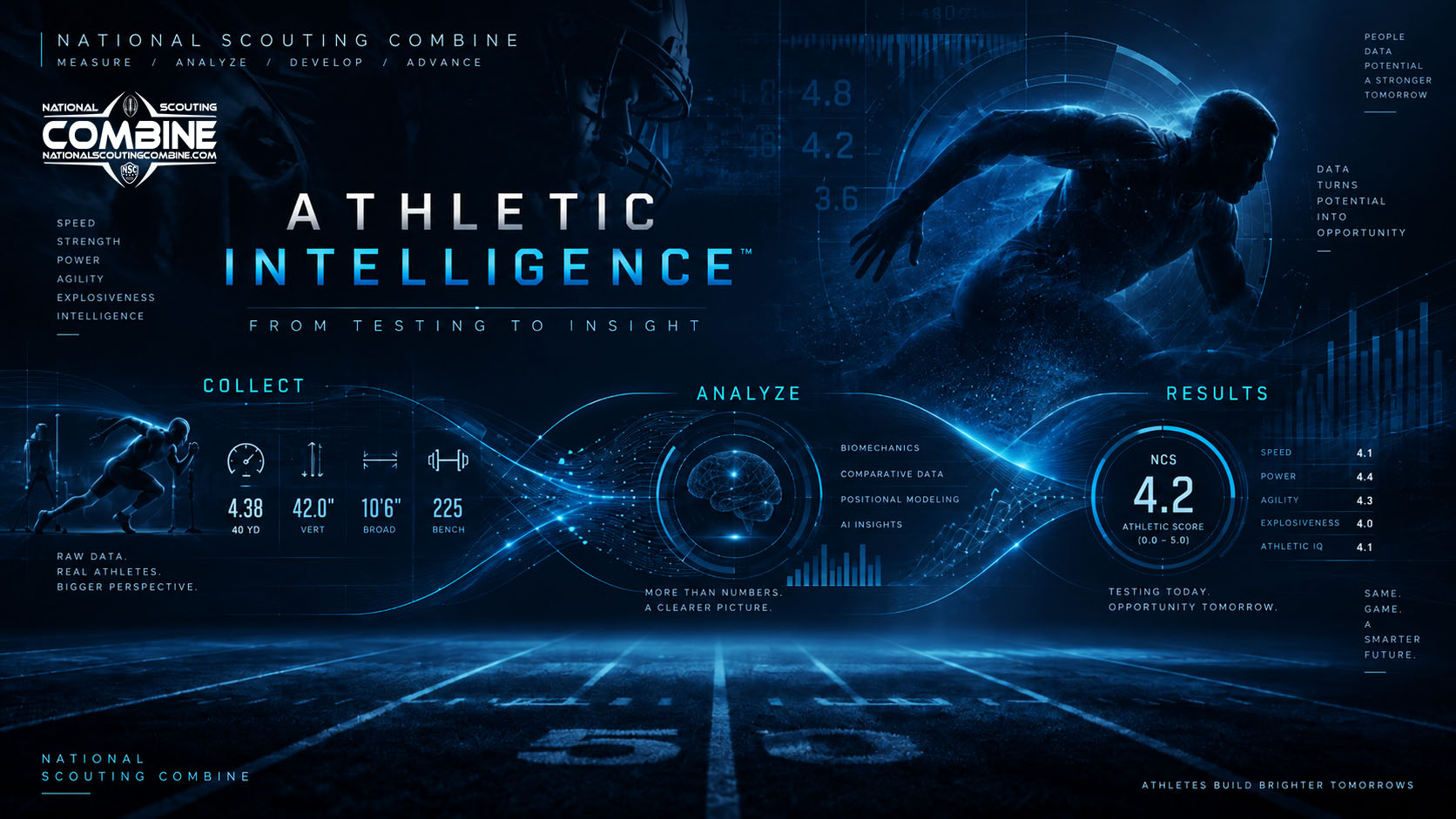
NSC research is designed to test where standardized athletic data adds value, where it does not, and how the NSCAP system can become more reliable for recruiting and scouting decisions.
Model validation
Data coverage
Position context
Outcome analysis
Decision support
The research question
Does verified athletic performance contain a repeatable signal?
The goal is not to prove that one number can scout football. The goal is to determine whether standardized athletic data can reliably improve filtering, comparison and prioritization when it is used alongside film, production, football intelligence, medical, character and scheme fit.
What a credible validation program should test
Input reliability
Was the test trustworthy?
Score stability
Does the grade behave consistently?
Outcome relationship
Does the signal track advancement?
Decision usefulness
Does it improve prioritization?
Current validation program
Build evidence around the questions evaluators will actually ask.
R-002
Position-Group Matchups & Team Success
Tests whether athletic advantages at matched position groups are associated with game outcomes more reliably than whole-team averages.
Football model
R-003
Data Coverage & Reliability
Measures how missing tests, substitutions and incomplete rosters change model confidence and accuracy.
Data quality
R-004
Quarterback Influence on Prediction Error
Separates quarterback effects from team athletic profile so the model does not over-attribute outcomes to combine traits.
Confounder control
R-005
Special Teams & Close-Game Outcomes
Examines whether kicking, return and field-position factors explain games where athletic matchup signals are otherwise close.
Game context
R-006
Travel, Time Zone & Circadian Effects
Tests environmental context that can influence performance independently of roster athletic ability.
Context layer
R-007
Roster Depth & Replacement-Level Value
Measures how two-deep quality and replacement players change a team’s effective athletic profile when starters are unavailable.
Availability
R-008
Athletic Return on Investment
Tests whether verified athletic traits can help identify under-recruited athletes whose later outcomes exceed their original recruiting visibility.
Recruiting
CORE
NSCAP Grade Outcome Validation
Tracks NSC athlete grades against advancement by competition level, with special attention to small-school athletes and the hypothesis that high grades can level the visibility gap.
Athlete outcomes
Method discipline
Validation is stronger when the rules are visible.
Locked eligibility
Football grades require at least three official tests across at least three performance categories. Ineligible profiles are not forced into the model.
Standardized inputs
Testing protocol, timing method and data cleaning come before scoring. Bad input should be removed—not hidden by a sophisticated formula.
Predefined comparisons
Position groups, thresholds and analytical rules should be defined before results are interpreted whenever practical.
The research program is intended to strengthen decision support and document limitations. It is not a claim that athletic testing alone predicts player success, game outcomes or roster fit.
Personnel & research partners
Test the system on a defined roster.
A focused pilot can compare NSC intelligence with your own evaluation process without asking your staff to change how it scouts.